Pass Guaranteed Quiz Latest Linux Foundation - New CKS Exam Review
Wiki Article
BONUS!!! Download part of BraindumpsVCE CKS dumps for free: https://drive.google.com/open?id=11U6elDgivDHoeUMi1fTp_OcuO4WUgc2g
Our CKS preparation materials are willing to give you some help if you want to be better in your daily job and get a promotion on matter on the salary or on the position. Those who have used CKS training engine have already obtained an international certificate and have performed even more prominently in their daily work. As it should be, they won the competition. So as they wrote to us that our CKS Exam Questions had changed their life.
The CKS exam is designed to test the candidate's ability to implement and manage security best practices in Kubernetes clusters. This includes securing the Kubernetes API, securing the network infrastructure, implementing secure storage and secrets management, and managing container security. Passing the CKS exam demonstrates that the candidate has the skills and knowledge to secure Kubernetes clusters and provides a valuable credential for professionals seeking to advance their careers in this field.
The CKS Exam is a valuable certification program for professionals who are responsible for securing Kubernetes environments. It provides a comprehensive evaluation of an individual's knowledge and skills in Kubernetes security and validates their expertise in this area. With the growing adoption of Kubernetes, the CKS certification can help professionals stand out in the job market and advance their careers in this field.
New CKS Exam Review Will Be Your Sharpest Sword to Pass Certified Kubernetes Security Specialist (CKS)
The valid updated, and real Linux Foundation CKS PDF questions and both practice test software are ready to download. Just take the best decision of your professional career and get registered in Linux Foundation CKS certification exam and start this journey with BraindumpsVCE CKS exam PDF dumps and practice test software. All types of Linux Foundation Exam Questions formats are available at the best price.It will enable you to perform well in the final CKS Exam. BraindumpsVCE offers CKS exam study material in the three best formats. Linux Foundation CKS Exam Questions, Web-based and desktop practice exam software. All these formats play a vital role in your Linux Foundation CKS exam preparation process.
The CKS Exam is intended for professionals who have experience working with Kubernetes and have a good understanding of the platform's architecture, components, and security features. CKS exam is targeted at security professionals, DevOps engineers, and system administrators who are responsible for securing Kubernetes environments. It is also suitable for individuals who are interested in learning more about Kubernetes security and want to validate their knowledge and skills in this area.
Linux Foundation Certified Kubernetes Security Specialist (CKS) Sample Questions (Q34-Q39):
NEW QUESTION # 34
SIMULATION
You must complete this task on the following cluster/nodes: Cluster: immutable-cluster Master node: master1 Worker node: worker1 You can switch the cluster/configuration context using the following command:
[desk@cli] $ kubectl config use-context immutable-cluster
Context: It is best practice to design containers to be stateless and immutable.
Task:
Inspect Pods running in namespace prod and delete any Pod that is either not stateless or not immutable.
Use the following strict interpretation of stateless and immutable:
1. Pods being able to store data inside containers must be treated as not stateless.
Note: You don't have to worry whether data is actually stored inside containers or not already.
2. Pods being configured to be privileged in any way must be treated as potentially not stateless or not immutable.
Answer:
Explanation:
See the Explanation belowExplanation: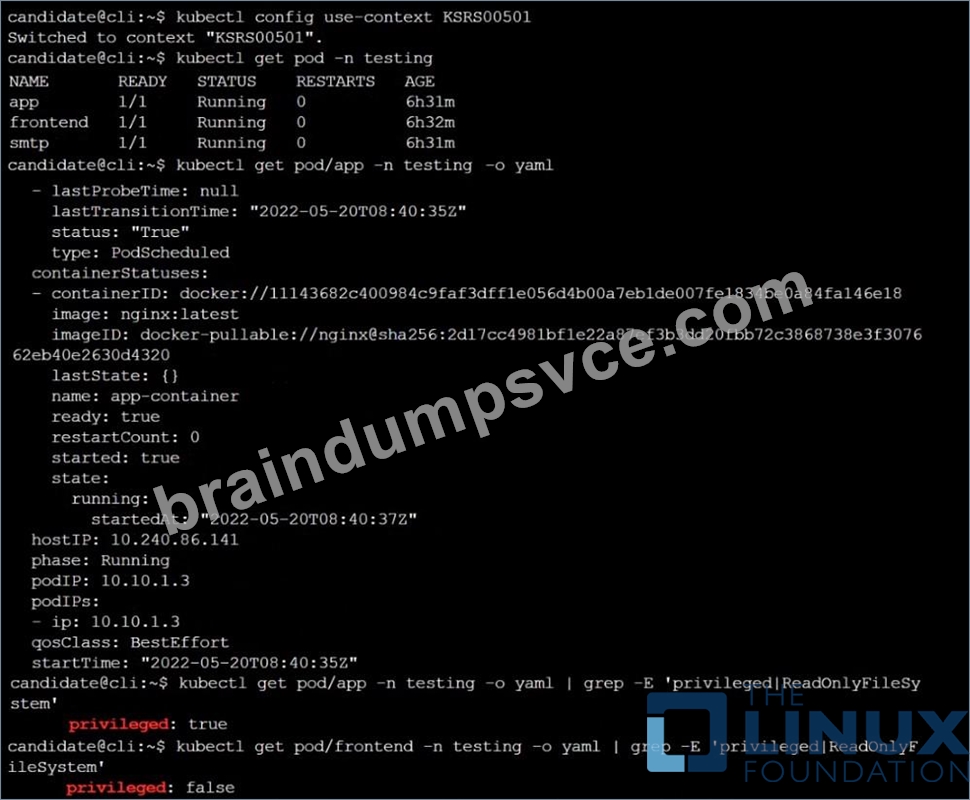
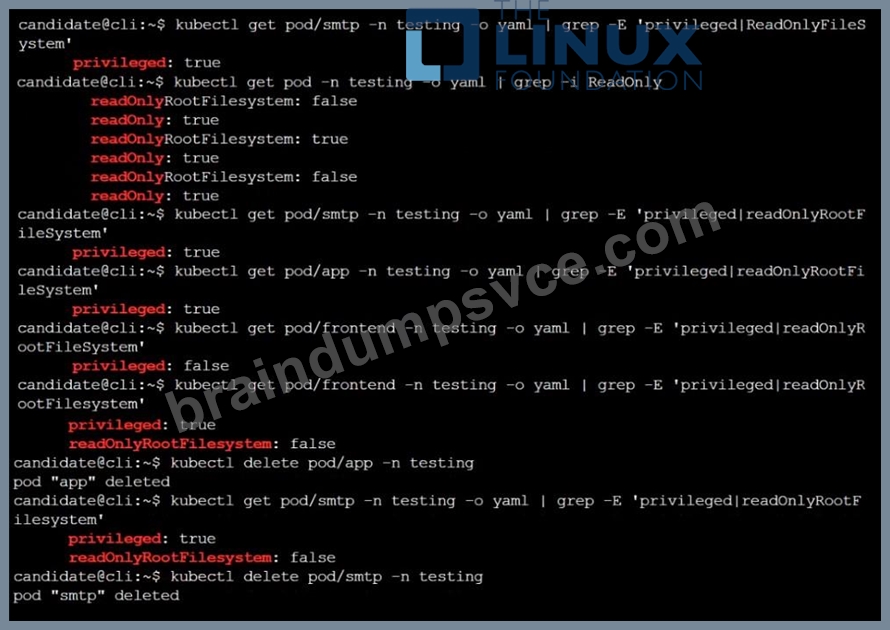
Reference:
https://cloud.google.com/architecture/best-practices-for-operating-containers
NEW QUESTION # 35
SIMULATION
Before Making any changes build the Dockerfile with tag base:v1
Now Analyze and edit the given Dockerfile(based on ubuntu 16:04)
Fixing two instructions present in the file, Check from Security Aspect and Reduce Size point of view.
Dockerfile:
FROM ubuntu:latest
RUN apt-get update -y
RUN apt install nginx -y
COPY entrypoint.sh /
RUN useradd ubuntu
ENTRYPOINT ["/entrypoint.sh"]
USER ubuntu
entrypoint.sh
#!/bin/bash
echo "Hello from CKS"
After fixing the Dockerfile, build the docker-image with the tag base:v2 To Verify: Check the size of the image before and after the build.
- A. Send us the Feedback on it.
Answer: A
NEW QUESTION # 36
You are running a Kubernetes cluster with a deployment named "my-app" that uses a container image from a public registry. You suspect that a recent deployment update may have introduced a vulnerability in one of the containers. You want to apply a security patch to the container image Without rebuilding it. Explain now you would implement this using a container patching tool like 'kpatch' and update the deployment.
Answer:
Explanation:
Solution (Step by Step) :
1. Install 'kpatch'
- Install the 'kpatch' tool on your system or within your Kubernetes cluster. 'kpatch' is a utility for patching running Linux kernels and user-space programs without rebuilding them.
2. Identify the Vulnerable Library:
- Use a vulnerability scanner like Trivy to identify the specific vulnerable library within the container image.
3. Patch the Vulnerable Library:
- Use 'kpatch' to apply the security patch to the vulnerable library within the running container.
- You can use the 'kpatch apply' command with the patch file and the containers process ID to apply the patch.
4. Update the Deployment
- While 'kpatch' allows for patching running containers, it's important to note that the patch will be lost when the container restarts. To ensure persistence, you need to update the deployment to use a patched container image:
- Obtain a patched version of the container image from a trusted source or build your own patched image.
- Update the "my-app" deployment configuration to pull the patched image from your registry.
5. Validate the Patch:
- After updating the deployment, verify that the patch has been successfully applied by running a vulnerability scan on the running container.
NEW QUESTION # 37
You are using a container image signed by a trusted entity. Describe the steps involved in verifying the signature of the image during the image pull process in Kubernetes.
Answer:
Explanation:
Solution (Step by Step) :
1. Generate the Signature:
- The trusted entity uses a signing key and algorithm to create a signature for the container image.
- The signature is typically stored as a separate file or within a manifest file associated with the image.
2. Configure the Kubernetes Cluster:
- Enable the 'ImageSignatureVerification' feature gate in your Kubernetes cluster. This feature gate enables the cluster to verity image signatures-
- Configure the 'ImageP01icyWebh00k' to point to a custom webnook server that will handle the signature verification process.
3. Implement the Webhook Server:
- Create a custom webhook server that will be responsible for verifying the image signature.
- This server will:
- Receive tne image manifest and signature from Kubernetes.
- Validate the signature using the trusted entity's public key.
- Return a success or failure status to Kubernetes based on the verification outcome.
4. Pull the Signed Image:
- When you pull the signed image from the registry, Kubernetes will:
- Fetch the image manifest and signature.
- Send them to the 'ImagePolicyWebhooR for verification.
- If the webhook returns a success status, the image will be allowed to run.
- If the webhook returns a failure status, the image will be rejected.
5. Example Implementation:
- You can use tools like 'cosign' or 'sigstores to generate and verify image signatures.
- Implement the webhook server using a programming language like Go or Python.
# Example using cosign to verify a signature cosign verify -key
- This command will use the provided public key to verify the signature of the specified image.
6. Security Considerations:
- Ensure that the webhook server is secure and only accessible to authorized Kubernetes components.
- Use robust authentication and authorization mechanisms for the webh00k server.
- Consider implementing rate limiting to protect against potential denial-of-service attacks.
NEW QUESTION # 38
SIMULATION
Fix all issues via configuration and restart the affected components to ensure the new setting takes effect.
Fix all of the following violations that were found against the API server:- a. Ensure that the RotateKubeletServerCertificate argument is set to true.
b. Ensure that the admission control plugin PodSecurityPolicy is set.
c. Ensure that the --kubelet-certificate-authority argument is set as appropriate.
Fix all of the following violations that were found against the Kubelet:- a. Ensure the --anonymous-auth argument is set to false.
b. Ensure that the --authorization-mode argument is set to Webhook.
Fix all of the following violations that were found against the ETCD:-
a. Ensure that the --auto-tls argument is not set to true
b. Ensure that the --peer-auto-tls argument is not set to true
Hint: Take the use of Tool Kube-Bench
Answer:
Explanation:
Fix all of the following violations that were found against the API server:- a. Ensure that the RotateKubeletServerCertificate argument is set to true.
apiVersion: v1
kind: Pod
metadata:
creationTimestamp: null
labels:
component: kubelet
tier: control-plane
name: kubelet
namespace: kube-system
spec:
containers:
- command:
- kube-controller-manager
+ - --feature-gates=RotateKubeletServerCertificate=true
image: gcr.io/google_containers/kubelet-amd64:v1.6.0
livenessProbe:
failureThreshold: 8
httpGet:
host: 127.0.0.1
path: /healthz
port: 6443
scheme: HTTPS
initialDelaySeconds: 15
timeoutSeconds: 15
name: kubelet
resources:
requests:
cpu: 250m
volumeMounts:
- mountPath: /etc/kubernetes/
name: k8s
readOnly: true
- mountPath: /etc/ssl/certs
name: certs
- mountPath: /etc/pki
name: pki
hostNetwork: true
volumes:
- hostPath:
path: /etc/kubernetes
name: k8s
- hostPath:
path: /etc/ssl/certs
name: certs
- hostPath:
path: /etc/pki
name: pki
b. Ensure that the admission control plugin PodSecurityPolicy is set.
audit: "/bin/ps -ef | grep $apiserverbin | grep -v grep"
tests:
test_items:
- flag: "--enable-admission-plugins"
compare:
op: has
value: "PodSecurityPolicy"
set: true
remediation: |
Follow the documentation and create Pod Security Policy objects as per your environment.
Then, edit the API server pod specification file $apiserverconf
on the master node and set the --enable-admission-plugins parameter to a value that includes PodSecurityPolicy :
--enable-admission-plugins=...,PodSecurityPolicy,...
Then restart the API Server.
scored: true
c. Ensure that the --kubelet-certificate-authority argument is set as appropriate.
audit: "/bin/ps -ef | grep $apiserverbin | grep -v grep"
tests:
test_items:
- flag: "--kubelet-certificate-authority"
set: true
remediation: |
Follow the Kubernetes documentation and setup the TLS connection between the apiserver and kubelets. Then, edit the API server pod specification file
$apiserverconf on the master node and set the --kubelet-certificate-authority parameter to the path to the cert file for the certificate authority.
--kubelet-certificate-authority=<ca-string>
scored: true
Fix all of the following violations that were found against the ETCD:-
a. Ensure that the --auto-tls argument is not set to true
Edit the etcd pod specification file $etcdconf on the master node and either remove the --auto-tls parameter or set it to false. --auto-tls=false b. Ensure that the --peer-auto-tls argument is not set to true Edit the etcd pod specification file $etcdconf on the master node and either remove the --peer-auto-tls parameter or set it to false. --peer-auto-tls=false
NEW QUESTION # 39
......
Study Materials CKS Review: https://www.braindumpsvce.com/CKS_exam-dumps-torrent.html
- Get Real And Easy-to-Use Linux Foundation CKS Dumps PDF Format ???? Simply search for ➠ CKS ???? for free download on { www.practicevce.com } ????Exam CKS Testking
- How Can Linux Foundation CKS Exam Questions Help You in Exam Preparation? ???? Easily obtain 【 CKS 】 for free download through ( www.pdfvce.com ) ????CKS Reliable Mock Test
- CKS Reliable Mock Test ???? Review CKS Guide ???? CKS Test Sample Questions ???? Simply search for ⮆ CKS ⮄ for free download on “ www.prepawayexam.com ” ????CKS Valid Dumps
- Practice CKS Exam ???? Vce CKS Files ???? Valid Dumps CKS Free ???? Open website ▛ www.pdfvce.com ▟ and search for ✔ CKS ️✔️ for free download ????CKS Valid Test Vce
- CKS Free Exam Questions ???? CKS Test Sample Questions ???? CKS Exam Braindumps ???? Easily obtain free download of 【 CKS 】 by searching on ➽ www.testkingpass.com ???? ????CKS Free Exam Questions
- CKS Lead2pass ???? CKS Test Sample Questions ???? New CKS Mock Test ☂ Search for ➤ CKS ⮘ and obtain a free download on ⏩ www.pdfvce.com ⏪ ????Vce CKS Files
- Pass Guaranteed Quiz CKS - High-quality New Certified Kubernetes Security Specialist (CKS) Exam Review ???? Easily obtain free download of 《 CKS 》 by searching on ▛ www.vceengine.com ▟ ????Reliable CKS Exam Sims
- How Can Linux Foundation CKS Exam Questions Help You in Exam Preparation? ???? Search for 【 CKS 】 and easily obtain a free download on ⏩ www.pdfvce.com ⏪ ????CKS Reliable Test Notes
- Review CKS Guide ???? Valid Dumps CKS Free ???? New CKS Mock Test ???? Open ▶ www.vceengine.com ◀ enter “ CKS ” and obtain a free download ????CKS Valid Dumps
- Pass Guaranteed Quiz CKS - High-quality New Certified Kubernetes Security Specialist (CKS) Exam Review ???? Open 《 www.pdfvce.com 》 and search for ➡ CKS ️⬅️ to download exam materials for free ????CKS Free Exam Questions
- CKS Reliable Mock Test ???? Practice CKS Exam ✉ CKS Reliable Test Notes ???? Open website 【 www.dumpsquestion.com 】 and search for ⏩ CKS ⏪ for free download ????CKS Test Sample Questions
- andrewnlua163103.blogoxo.com, begindirectory.com, socialwebleads.com, studio-directory.com, ragingbookmarks.com, myportal.utt.edu.tt, myportal.utt.edu.tt, myportal.utt.edu.tt, myportal.utt.edu.tt, myportal.utt.edu.tt, myportal.utt.edu.tt, myportal.utt.edu.tt, myportal.utt.edu.tt, myportal.utt.edu.tt, myportal.utt.edu.tt, mysocialport.com, zaynqhgm389958.wikimillions.com, pennyudbp606222.bloggerswise.com, bookmarklinkz.com, Disposable vapes
P.S. Free & New CKS dumps are available on Google Drive shared by BraindumpsVCE: https://drive.google.com/open?id=11U6elDgivDHoeUMi1fTp_OcuO4WUgc2g
Report this wiki page